
Crowdtesting Meets AI: 5 Platforms That Actually Deliver Results
Traditional crowdsourced testing has always promised scale, but it’s often come with headaches.


Teams get flooded with noisy results, tester quality varies wildly, and spinning up a new cycle can take weeks.
The scale of these challenges is striking: the crowdsourced testing market already reached $3.5 billion in 2025 and is expected to more than double to $8.1 billion by 2035, yet the same operational pain points continue to surface.
When QA teams must manually coordinate a global network of testers, the friction is measurable. 22% of companies cite test stability as their biggest struggle, 20% wrestle with coverage gaps, and 35% say manual testing is their most time-consuming activity.
Worse, the signal-to-noise problem remains: duplicate or low-priority bug reports consume bandwidth, while critical defects risk slipping through.
This is where AI is starting to change the model. Adoption of AI in testing has increased from 7% in 2023 to 21% in 2025, but the reality is that 82% of testers still rely on manual testing every day.
Crowdtesting vendors are incorporating AI to automate tester assignment, optimize coverage, and filter noise in ways that directly address those longstanding frustrations.
Why does this matter now? Because product and engineering leaders in late-stage vendor evaluations don’t have patience for buzzwords.
They need tangible proof that an AI-powered testing service will actually remove friction, accelerate cycles, and protect release quality.
That’s what this article is about: cutting through the hype and spotlighting five platforms that are truly using AI in meaningful ways.
Not all “AI-powered” solutions are equal as some offer little more than workflow shortcuts, while others, like Testlio’s LeoAI Engine, have built brilliant orchestration systems.
Top 5 AI-Powered Crowdsourced Testing Platforms That Actually Deliver
When you start looking closely at AI-powered crowdtesting vendors, it doesn’t take long to see the gap.
A few genuinely use AI to orchestrate testing end-to-end, while many others stop at surface-level features.
Below, we compare five leading platforms, examining how each leverages AI and where each excels.
1. Testlio – AI-Orchestrated Testing at Enterprise Scale
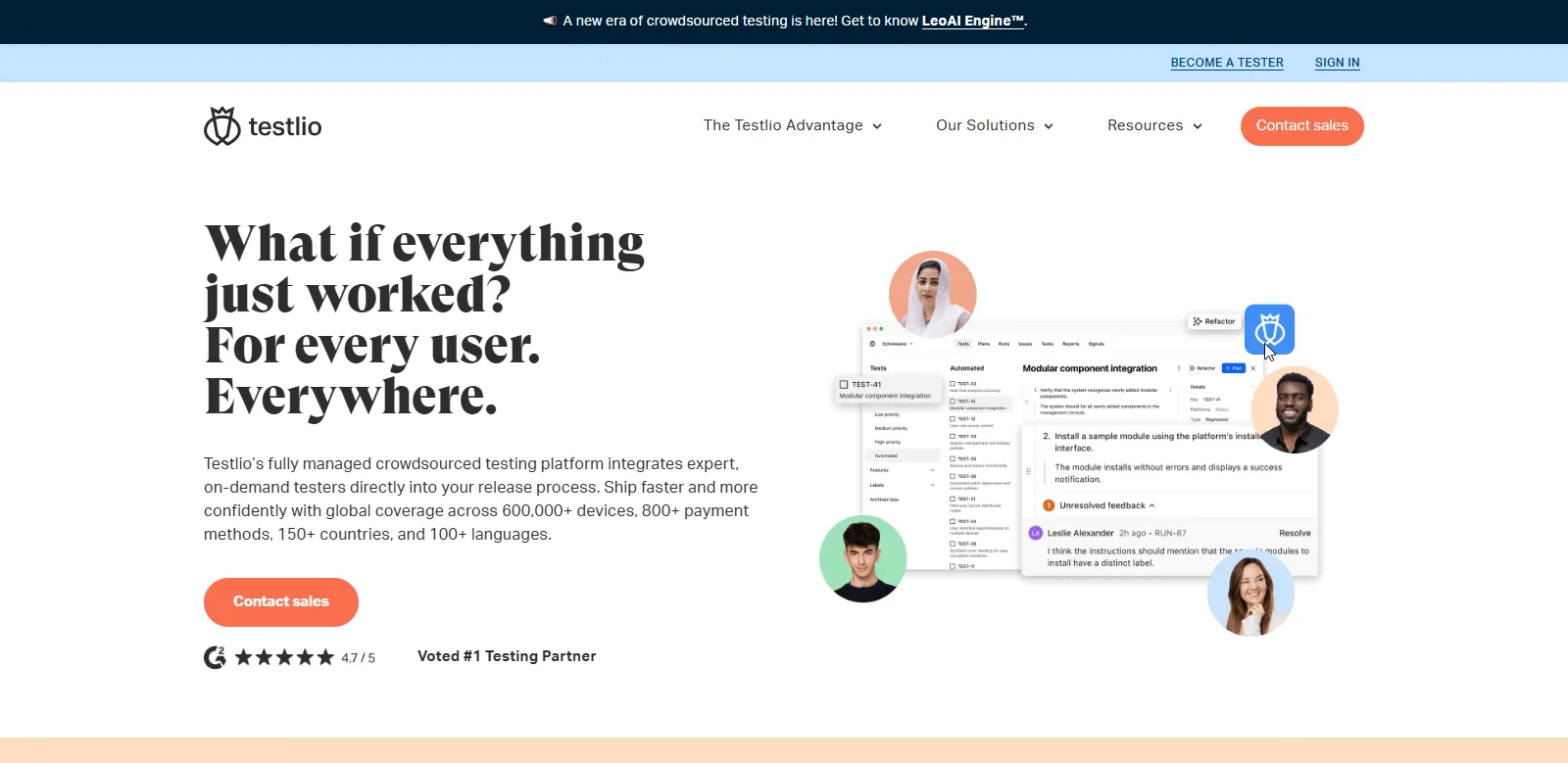
Testlio is not just another crowdtesting platform. It is a fully managed QA service with AI woven into the core of its delivery model.
At the heart of this approach is the LeoAI Engine. This intelligence layer runs the full testing lifecycle: selecting the right testers, building and scheduling execution plans, and learning from past results to improve each new cycle.
What once took days of manual coordination now happens in hours. QA leaders gain faster staffing, smarter execution, and cycles that get sharper over time.
Early adopters have reported measurable improvements. A major reason for these gains is LeoMatch, Testlio’s real-time talent matcher.
It evaluates more than 100 live signals such as skills, devices, locations, past performance, and even tester availability.
The system then assembles the best possible team for the project and continually re-ranks them as conditions shift. This gives teams immediate access to qualified testers, without delays or uncertainty.
The outcomes are evident across industries:
- Ride-sharing company: Cut bug validation times in half and scaled QA across dozens of markets and hundreds of payment flows without extra manual effort.
- Streaming platform: Coordinated testing across 600,000+ devices and 100+ languages, ensuring smooth global feature launches.
- Luxury retailer: Mobilized 157 testers in 20+ countries and 250+ devices, completed 213 test cycles, and achieved a 10/10 Net Promoter Score.
Clients also point to the reduction of noise and sharper bug relevance. LeoAI goes beyond staffing by prioritizing high-risk cases, predicting likely failure points, and identifying areas where issues are most likely to emerge.
Crowdtesting shifts from reactive defect chasing to proactive, data-driven quality assurance. Behind this orchestration is Testlio’s curated tester network.
Only around 3% of applicants are accepted, and each tester is continuously rated and reviewed. Many stay with the same product across multiple sprints to build context, while AI rotates in new testers to keep perspectives fresh and coverage broad.
This mix of continuity and variety delivers both strong regression depth and effective exploratory insight.
Enterprise needs are built into the platform. Testlio integrates with Jira, GitHub, TestRail, and CI/CD pipelines to ensure bug reports flow naturally into existing workflows.
Security and compliance are equally strong, with ISO 27001:2022 certification, GDPR compliance, and strict NDA-backed participation. Client data is never used to train external AI models.
It is no surprise that Testlio holds an industry-leading 4.7/5 rating on G2, with customers consistently highlighting its impact on release speed, product confidence, and overall quality.
2. Test IO – Crowdtesting with Workflow AI Assistance
Test IO, now part of EPAM Systems, is one of the more established names in crowdtesting.
It provides companies with on-demand access to a global tester pool of more than 400,000 testers across 150+ countries, available around the clock.
The platform is primarily used for functional bug finding and exploratory testing. Reports include screenshots or video as standard, and clients can communicate directly with the tester who discovered the issue. Bug fix confirmations are also fast.
Once a developer marks an issue as resolved, the crowd can re-test and confirm the fix within about 30 minutes, which is valuable for teams working on short release cycles.
AI within Test IO is focused on workflow support. Features include AI-assisted test case generation, anomaly detection, test coverage suggestions, and duplicate bug filtering.
These capabilities help speed up results and reduce repetitive tasks, but the execution of tests still depends on human test managers and the tester community.
One of the biggest advantages of Test IO is speed. Thanks to its large network and efficient processes, clients often see results within hours of starting a test cycle.
Security is also a priority. All testers sign NDAs, and sensitive projects can be restricted to a vetted group of professionals.
For mid-market and agile teams, Test IO provides a practical way to scale real-world testing without building in-house teams.
It is particularly useful for regression testing in e-commerce and media apps, beta testing new features, and gathering UX feedback across different regions.
3. TestingXperts – AI-Augmented QA Services

TestingXperts (Tx) is a QA services provider that blends human expertise with in-house AI tools. Unlike pure crowdtesting platforms, TestingXperts follows a services-led model.
They provide managed testing teams and consultative QA improvements tailored to each client.
Their strength lies in the way they embed AI and machine learning into these services. Industry analysts often recognize them as leaders in applying AI to enterprise QA.
Core capabilities include AI-driven defect prediction to anticipate where bugs are most likely to occur and intelligent test optimization to focus on high-risk areas.
TestingXperts has also built proprietary AI accelerators that analyze code changes alongside past test results.
These accelerators flag high-risk modules so teams can prioritize them during regression testing. The approach reduces defect leakage and avoids spending cycles on low-risk areas.
Another area where TestingXperts puts AI to work is in shift-right testing. By analyzing user interaction data, logs, and support tickets, their systems can detect patterns that humans might miss.
This includes sentiment analysis of user reviews and spotting anomalies in error rates, both of which alert QA teams to issues emerging in production.
These insights then inform pre-release coverage, effectively closing the loop between real-world usage and test design.
For enterprise applications where user experience is critical, this feedback loop is valuable. The AI helps prioritize fixes and enhancements based on what is actually impacting end users.
When clients engage TestingXperts, they receive both skilled testers and access to AI-powered frameworks such as Tx-Automate, Tx-GPT, and Tx-Insights. Orchestration is handled as part of the managed service.
The benefit is a highly tailored solution where AI is applied in the context of your product and processes. The trade-off is that effectiveness depends on the engagement structure and the data available.
AI in this model is woven into the consulting rather than delivered as a standalone platform.
Their tools can accelerate test creation, run predictive analytics, and even self-heal automation scripts, but they are not directly customer-facing. Clients use them through TestingXperts’ teams.
4. Qualitest – Data-Driven QA with AI Tools
Qualitest is one of the largest pure-play QA companies in the world and has invested heavily in AI to modernize testing.
Their proprietary platform Qualisense, shows how they apply AI to improve outcomes. It can optimize test coverage, prioritize test cases, and even eliminate redundant tests.
The predictive analytics are particularly noteworthy. By using machine learning to plan the order of test execution, Qualisense can target the riskiest areas first.
Qualitest reports that this method can speed up defect detection by up to 95%.
In practice, this means AI is deciding which tests to run more often and which ones to push down the priority list. Human intuition is supplemented by data-driven decision-making instead of relying only on exhaustive regression sweeps.
Qualisense also uses natural language processing (NLP) to analyze requirements and bug reports. This helps flag inconsistencies and risk areas early.
This approach is instrumental in enterprise environments. When test suites contain thousands of cases and time for regression is limited, AI helps ensure the most important scenarios are covered.
On the crowdsourced side, Qualitest’s core business has long been providing dedicated QA engineers and managed teams. However, they also offer Managed Crowd Testing as part of their services.
To deliver this, Qualitest often partners with existing crowd providers. That said, the crowd element may not be as deeply integrated with Qualisense.
It often works as a bolt-on service, with logistics still involving manual steps or relying on partner platforms rather than Qualisense itself.
5. Cigniti– Predictive QA Platform with Crowdsourcing in the Mix
Cigniti (now part of Coforge), is a global QA leader that has built its own IP and platforms to bring AI into testing.
At the center of their approach is the BlueSwan™ platform, a suite of tools for next-generation quality engineering. Its components span requirements analysis, test automation, and predictive defect analysis.
One of its modules, Verita™, is an AI-driven dashboard that provides predictive analytics for defect prevention and performance. It analyzes past defects, code changes, and system data to identify risk areas and alert teams before issues occur.
Another module applies sentiment analysis to user feedback. By scanning customer reviews or social media comments, the system can surface early signals of where a product might be failing or where improvements are needed.
Cigniti also applies machine learning to test optimization. Tools like Impact Analyzer automatically update test cases when applications change and help optimize test suites to reduce redundancy.
Together, these capabilities position Cigniti as a vendor focused on making QA predictive and preventive rather than reactive.
On the crowdsourced side, Cigniti offers access to a globally vetted community of more than 50,000 testers for real-world validation across cloud, IoT, and mobile apps.
Instead of running its own crowd platform, Cigniti partners with established providers such as Passbrains to mobilize testers on demand.
This allows them to cover new devices or geographies as required. The logistics, however, are usually managed through these partnerships rather than directly through an AI engine.
Cigniti acknowledges the risks of crowdtesting, including potential IP, quality, and security concerns, and addresses them with NDA agreements, compliant partner platforms, and additional safeguards.
Their emphasis is often on the added value surrounding the tests, such as logistical planning and detailed reporting.
Cigniti’s strength lies in its analytics-driven QA capabilities, with BlueSwan delivering foresight into quality issues, and its ability to scale testing through crowdsourcing when needed.
What to Look For When Choosing an AI-Powered Crowdtesting Partner
You have to look beyond the buzzwords when selecting a crowdsourced testing vendor.
Here are key factors and questions to consider to ensure you get real value and not just hype:
Genuine AI Capabilities
When you are evaluating vendors, don’t stop at the claim that a platform is “AI-powered.” The important question is how that AI is actually being applied.
Some platforms use AI in small ways, such as grouping duplicate bugs or suggesting test coverage. That can be helpful, but it is a far cry from full orchestration.
For example, a holistic AI engine like Testlio’s LeoAI goes much further. It handles tester selection, scheduling, and results analysis as part of a continuous loop.
One approach reduces overhead across the entire lifecycle, while the other only trims a few admin steps.
The best way to distinguish between them is to request specific outcomes. Has the platform delivered faster cycle times? Higher bug discovery rates? More efficient coverage?
If a vendor can’t show real results, chances are their “AI” is more marketing than substance.
Tester Vetting and Quality
The power of any crowdtesting platform depends on the people behind it. That is why it is worth asking how a vendor vets and manages its tester community.
Top providers maintain strict standards. For example, Testlio accepts only about 3% of applicants and continually rates testers to ensure quality stays high.
Consistency is crucial as well. The best setups provide a core team of testers who remain with your project throughout its cycles, building context over time.
At the same time, AI can rotate in fresh testers when needed to bring new perspectives.
A well-managed and skilled crowd delivers meaningful results and less noise. By contrast, an uncurated swarm of random users often creates more work than value.
Security and Data Protection
Using a crowdsourced testing platform should never mean lowering the bar on security. It is essential to confirm how a vendor protects your application and the data it contains.
Strong providers put safeguards in place from the start. This includes NDA agreements for all testers, secure test environments, and compliance with standards such as SOC 2, ISO 27001, and GDPR.
If you work in a sensitive sector like finance or healthcare, dig deeper. Ask if the vendor can restrict testing to specific geographies or to testers who have undergone background checks.
Also, make sure you understand how the platform’s AI models use your data. Reputable vendors will not train public models on your information and will implement clear safeguards.
The right partner will treat your product and data with the same level of protection you expect from your own teams.
Global Scale and Device Coverage
One of the biggest benefits of crowdtesting is reach, but only if the vendor can actually provide testers where you need them.
Ask about the size and diversity of the tester pool. How many countries and languages are represented? How many real devices and payment systems can they cover?
For example, Testlio has testers in more than 150 countries, with access to over 600,000 device and OS combinations and more than 800 payment method scenarios. That level of coverage is critical if your app requires localization or validation on obscure hardware.
Also consider how quickly the platform can scale. Can they ramp up dozens of testers in a single day to support a major release?
The strongest vendors use AI to assemble and deploy teams in real time, which makes all the difference under tight deadlines.
Integration and Workflow Alignment
A good crowdtesting service should plug right into the way your team already works. Integration is key.
Check for pre-built connections with tools like Jira, Azure DevOps, and CI/CD pipelines so bug reports flow directly into your system without extra steps.
Some vendors also provide APIs or webhooks for customization. This flexibility lets you shape how testing data fits into your processes.
Reporting matters too. Dashboards should provide clear, actionable insights such as coverage metrics, defect trends, and cycle summaries that your team can use to make informed decisions quickly.
Crowdtesting should augment your internal QA, not run as a separate silo.
AI can add value here by analyzing results across cycles, but it is just as important that you have full visibility and control over those insights.
Track Record and Support
Crowdtesting at enterprise scale is complex, so you want a partner that has done it before with clients like yours and has proven methodologies to back it up.
Case studies and client references are a good place to start. They show not just what the vendor claims, but what they have delivered in practice.
User feedback is another valuable signal. Both Testlio and TestingXperts hold around a 4.7 out of 5 rating in user reviews, a strong indicator of customer satisfaction.
It is also worth looking at the level of account management and support a vendor provides. The best platforms don’t just give you access to testers but also give you guidance and service that fit your needs.
When you are close to making a decision, consider running a pilot test cycle with each shortlisted vendor. Comparing the bug quality, the noise level, and the performance of AI features side by side can be eye-opening. On paper, platforms may sound similar, but in practice the differences often stand out quickly.
Crowd + Intelligence: The Future of QA
Software quality assurance is entering a new era where the strengths of crowdtesting and artificial intelligence come together.
A crowd on its own can quickly become overwhelming. Scale without orchestration is just “chaos with headcount.”
AI alone cannot fill the gap either, because it lacks the creativity, intuition, and context that real users bring.
The real breakthrough comes when the two are unified. A vetted global crowd of expert testers, orchestrated by intelligent AI, delivers the best of both worlds: real-world diversity and coverage, elevated by the speed, precision, and adaptive learning of machine intelligence.
Not every vendor claiming “AI-powered” crowdtesting delivers this in practice. Only a handful have built AI into the core of how tests are executed and how testers are engaged. Testlio is one of those few.
At the heart of Testlio is the LeoAI Engine™, an orchestration system that automates the operational challenges that once made crowdtesting difficult to manage. Instead of drowning in coordination, QA teams see faster, cleaner results.
With Testlio crowdsourced testing, enterprises gain:
- Faster release cycles through AI-driven tester matching and orchestration
- Higher defect catch rates by intelligently prioritizing risk and coverage
- Seamless scalability with 10,000+ vetted testers across 150+ countries, 600,000+ devices, 100+ languages, and 800+ payment methods
- Tight DevOps integration with tools like Jira, GitHub, TestRail, and CI/CD pipelines for real-time visibility
- Enterprise-grade security and compliance with ISO 27001:2022 certification, GDPR alignment, NDA-backed testers, and strict safeguards that ensure customer data is never used to train public AI models
Only about 3% of tester applicants are accepted into Testlio’s community, creating a curated global network of domain experts across industries.
Choosing a partner is about more than checking the “AI-powered” box. The right solution should feel like an extension of your own QA and engineering teams, taking on the heavy lifting so your people can focus on strategic priorities.
For teams looking to scale testing, accelerate release cycles, and improve product reliability, Testlio is the proven choice.
With its LeoAI Engine, global reach, and managed service model, Testlio transforms QA from a cost center into a catalyst for innovation.
Learn more about how Testlio can empower your team to deliver quality at velocity.