
How to Select a Reliable Crowdsourced QA Testing Partner
If you have ever searched for a crowdsourced testing partner, you have probably seen the same promise repeated: “thousands of devices, hundreds of geographies.” While impressive at first glance, these vanity metrics rarely reflect the true quality of a QA partnership.


We have seen teams choose vendors with massive tester networks, only to be left with irrelevant bug reports, weak triaging, and delayed releases. Scale alone is not what drives quality. What matters is whether the partner can align with your release cadence, communication style, industry requirements, and product expectations.
This guide breaks down the factors that truly matter when selecting a crowdsourced testing partner. It will help you look past surface-level claims and ask the right questions, such as:
- Do they have experience in my industry?
- Are they a good cultural fit with our team?
- Can they integrate with the tools and workflows we already use?
Let’s dive in.
Why Do Most Crowdsourced Testing Vendors Fall Short
Crowdsourced testing promises flexibility, speed, and scale. Yet in practice, many vendors fail to deliver on those promises. Teams often discover that instead of reducing risk, poorly run programs introduce new challenges. The most common pitfalls include:
- Scale over substance: Many vendors focus on sheer volume of output, i.e., the number of test cases and bugs, but often ignore actual testing processes and quality.
- Lack of proper tester vetting: Without proper vetting for qualified domain expert testers, such as those in fintech, education, or healthcare, you will end up buried in irrelevant bug reports and spend valuable time sorting out noise instead of gaining actionable insights.
- Security blind spots: The lack of security protocols and adherence to best industry practices make the client’s sensitive data vulnerable.
- Poor communication: Timezone differences and the absence of designated points of contact lead to communication delays and frustrations.
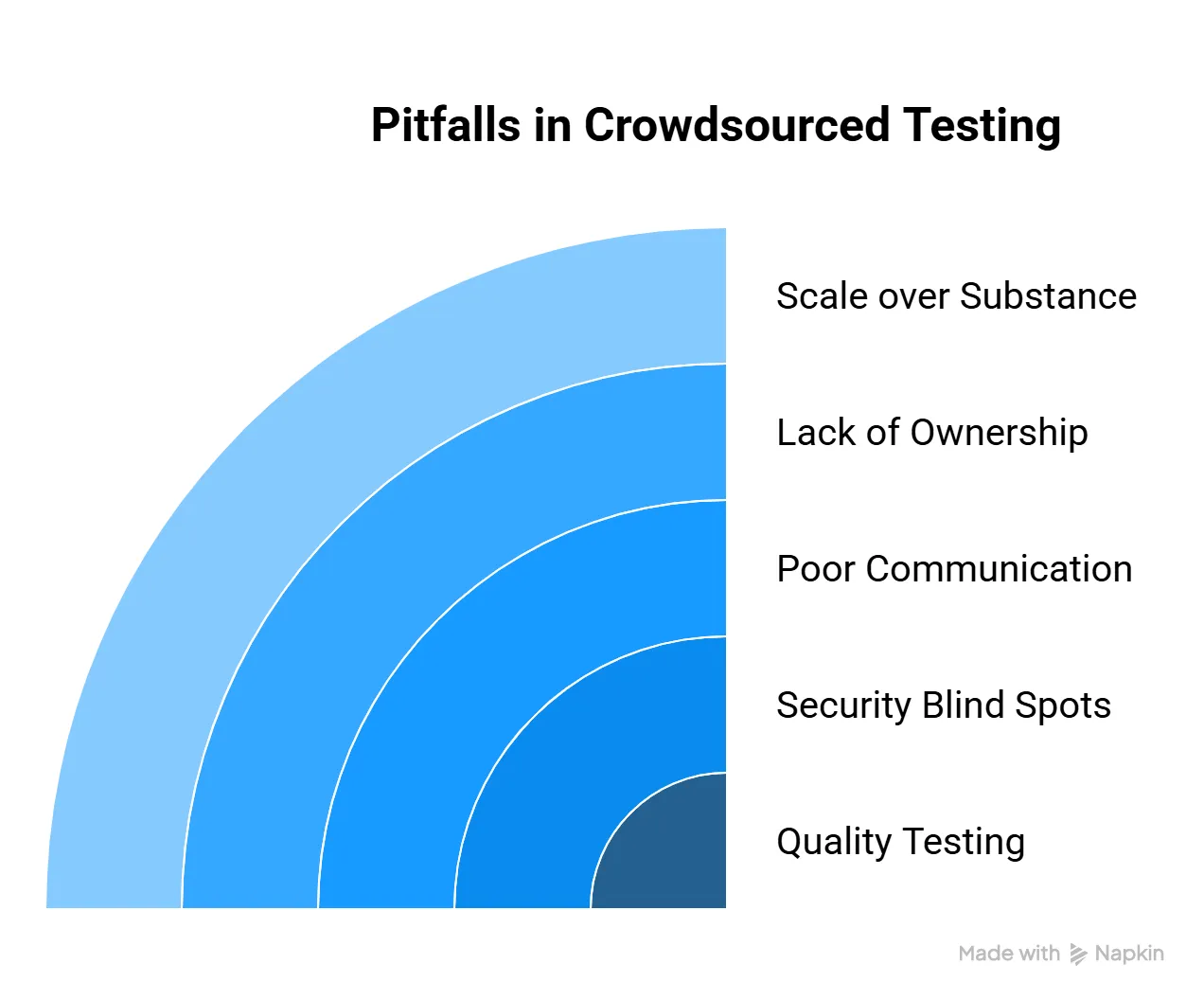
These points highlight the importance of investing considerable effort in your vetting process to prevent these pitfalls in the future.
Partner Evaluation Checklist
Choosing the wrong QA partner is not just inconvenient, it can slow down releases, create security risks, and cost you far more than expected. This is why it is critical to evaluate vendors from every angle before committing. The right partner should strengthen your team, not create liabilities.
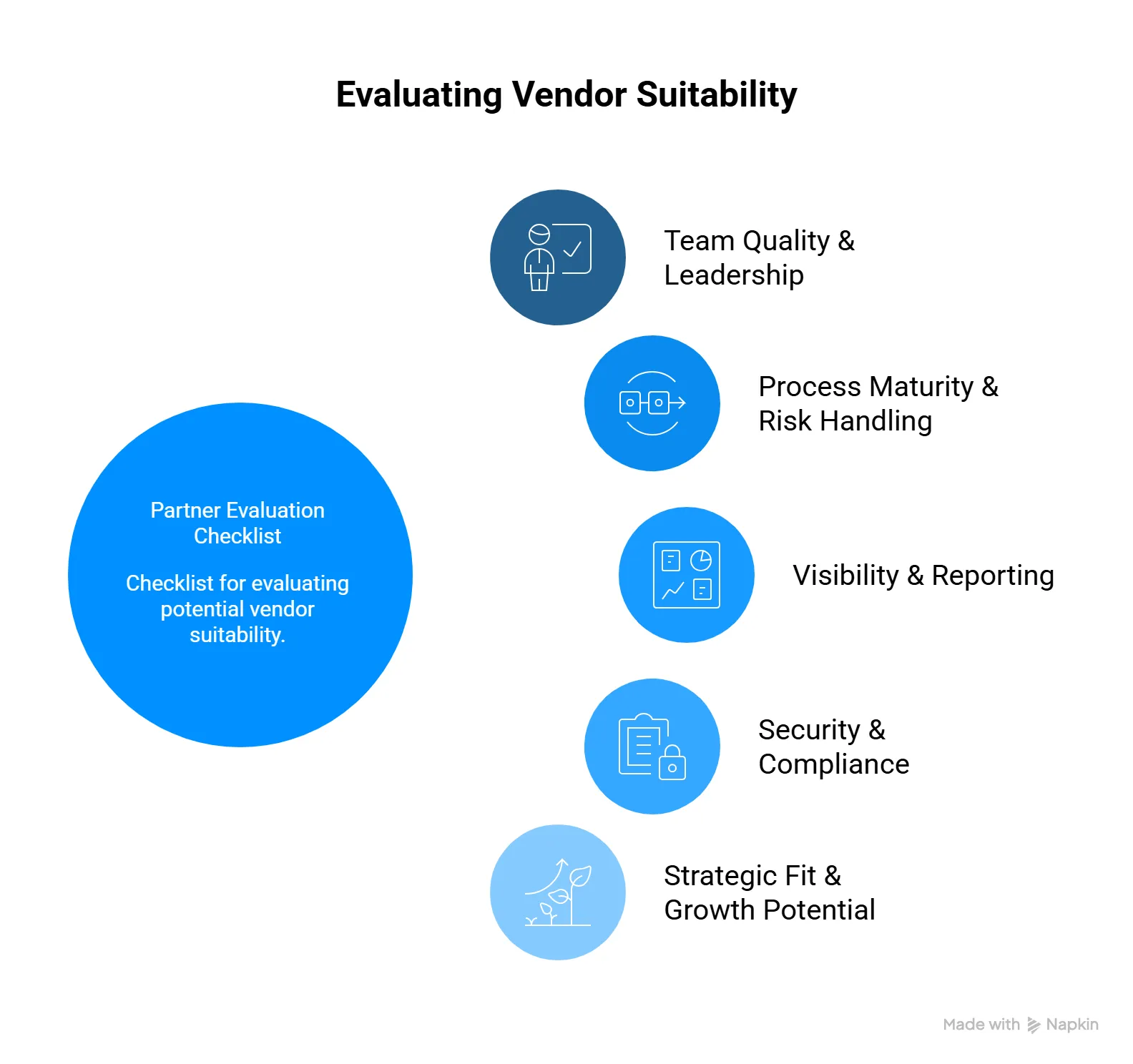
The checklist below highlights the most important areas to review when assessing a QA vendor. For each, we outline the risks of overlooking it, the questions you should ask, and what to look for in a reliable partner.
1. Team quality & leadership
The people behind the testing are as important as the processes they follow. Strong tester vetting and capable QA leadership will determine whether the partnership will work in your favor. Ask the following questions when looking for team quality and leadership:
1a) Are the testers vetted and specialized?
Tester vetting directly impacts testing quality. If testers lack domain expertise, you end up with irrelevant bug reports, false alarms, and missed edge cases.
For example, a tester who has never worked with fintech applications may flag two-factor authentication (2FA) prompts as a usability issue. In reality, these prompts are required for security and compliance.
1b) Is there authentic leadership or a placeholder QA lead?
Have you ever had several testers reach out with the same question at the same time? This is what happens when a vendor provides a group of testers without a clear lead. Instead of reducing your workload, the partnership forces your team to manage bug triage, test case assignments, and communication.
Before committing, ask if you will have a dedicated QA lead or test architect who serves as the main point of contact. A trustworthy partner will provide leadership that ensures:
- A single accountable lead
- Proactive communication habits
- Independent management of tester assignments and scope
2. Process maturity & risk handling
Once you confirm team quality, look at how the vendor manages testing as a whole. Mature processes and clear risk handling make the difference between simply finding bugs and protecting your release from serious issues.
2a) Can the vendor handle timely issue escalation and management?
A good QA team can find bugs. A great QA team knows which bugs can derail a release. Without a proper system, high-priority issues like login failures can slip into production while triage boards are filled with low-priority items.
Research shows that 35% of teams using crowdsourced testing reported inconsistent test quality and only 60% of testers followed test prioritization guidelines. These failures are usually caused by missing escalation paths and poor triage practices.
Ask vendors how they prioritize and escalate bugs. Look for:
- Clear tagging for severity levels (P0, P1, and so on)
- A defined escalation path with named contacts
- A structured bug lifecycle and triage process
2b) Is the outsourced team productive enough to keep up with your release schedule?
Picture this: your release day arrives, but your QA partner is still testing yesterday’s build. When timelines are out of sync, outsourcing becomes a bottleneck instead of an accelerator.
So it is essential that you discuss your release cycles in detail and confirm that the vendor can commit to it in writing.
2c) Can the vendor integrate with your engineering processes and feedback loop?
Smooth integration reduces friction and avoids wasted effort. If your team uses GitLab while the vendor insists on QTest, you will spend more time reconciling tools than fixing bugs.
Ask how the vendor adapts to your development stack and feedback loops. The most effective partners will have:
- Bi-directional feedback loops.
- Active QA involvement in sprint planning.
- Overlapping management tools.
3. Visibility & reporting
Even with capable testers and strong processes, you need visibility into what is happening. Without transparency, duplicate bugs, missed test cases, and delayed insights are almost guaranteed.
3a) Does the vendor provide clear visibility through dashboards and reports?
Real-time visibility helps you track what is being tested and who is responsible. Without it, duplicate bugs pile up and reduce efficiency.
In fact, research shows that 9–39% of bugs in Firefox and Eclipse databases were duplicates, caused by testers not being able to see whether an issue was already logged.
Ask vendors if they offer:
- Real-time test dashboards
- Traceability of who tested what
- Historical bug tracking per tester

Explore the Testlio report dashboard to understand how visualized results provide visibility and traceability.
3b) What testing metrics and reports does the vendor focus on?
Metrics should reveal patterns, not just count bugs. For example, a digital education company improved post-release quality by tracking defect density, test case effectiveness, and recurrence rate. These insights allowed them to prioritize the right areas and reduce failures after release.
Look for partners that customize QA KPIs and track incident recurrence so you can measure real progress in product quality.
4. Security & compliance
For a reliable QA partner, security and compliance are not an afterthought; they must be built into their processes to ensure the same robust security standards as your internal teams.
4a) How does the vendor protect your user and application data?
When testers are distributed globally, weak access control can quickly turn into a serious breach. A stark reminder is the 2015 Anthem healthcare breach, where 37.5 million records were compromised and the company paid $115 million in settlements.
Ask vendors how they secure builds, encrypt credentials, and enforce non-disclosure agreements. Strong vendors will:
- Enforce NDAs with all testers
- Maintain ISO or equivalent certifications
- Use virtual desktops for test environments
- Log IP access consistently
5. Strategic fit & growth potential
Crowdsourced testing is not static. As your product and processes evolve, your QA partner should grow with you. Strategic alignment and cultural fit are just as important as technical expertise.
5a) Will the outsourced team grow and evolve as your product launches into production?
If your internal teams move toward CI/CD pipelines and AI-driven test generation but your vendor is still logging bugs in spreadsheets, the gap will hold you back.
Ask vendors how their practices have changed in the past year and how they plan to evolve. Strong partners will:
- Adopt AI and machine learning tools
- Upskill testers regularly
- Provide a roadmap for tool and process improvements
- Offer automated test orchestration
At Testlio, we recognized the growing demand for pairing AI intelligence with human expertise. So we adapted with the LeoAI Engine™, which applies intelligence across the testing lifecycle by learning from past runs, identifying coverage gaps, and orchestrating smarter test cycles. Instead of simply running tests and logging defects, it evolves with your product and ensures QA scales alongside your business.
5b) Is the outsourced team a cultural fit?
Even with great skills, misaligned working styles can cause friction. For example, if your team works fixed hours and expects quick responses while the vendor follows flexible hours with inconsistent availability, communication will suffer.
Look for vendors who:
- Practice transparent and respectful collaboration
- Understand agile and Scrum ways of working
- Are comfortable with asynchronous communication
- Treat feedback as a natural part of the process
Closing Thoughts
Choosing a QA partner is about more than finding someone who can execute test cases. You need a team that collaborates with you, adapts as your product evolves, and provides clarity at every stage of the release cycle. A vendor that cannot demonstrate these qualities is not a partner. They are simply an overhead.
At Testlio, we combine a global community of vetted testers with expert QA leadership and AI-powered capabilities through our proprietary intelligence layer, LeoAI Engine™. This approach ensures that testing is both thorough and aligned with your business goals. The result is faster releases, reduced risk, and greater confidence in every launch.